How multidisciplinary team (MDT) consultations work at Guangdong Provincial Hospital of Chinese Medicine — and how one European couple prepared for a complete TCM assessment.

Two Trends Converging in Guangzhou
Something interesting is happening across China’s healthcare landscape. Traditional Chinese Medicine (TCM) is drawing growing interest from international residents, while leading Chinese hospitals are reorganizing complex care around multidisciplinary team (MDT) consultations.
The two came together in March 2026, when Guangdong Provincial Hospital of Chinese Medicine was named among the first batch of 25 Guangdong International Medical Service Pilot Hospitals — the only public TCM hospital on the list, according to the official announcement. For international patients in Guangzhou, Shenzhen and Boao Lecheng, centuries-old diagnostic traditions, modern hospital infrastructure and one-stop multi-specialty visits are becoming genuinely easier to combine.
This guide explains what an MDT consultation at a TCM hospital involves, what a complete TCM assessment includes, and how one international couple structured their visit request — a template worth copying.
What an MDT Consultation Means at a TCM Hospital
MDT stands for multidisciplinary team. In an MDT consultation, specialists from several departments assess a case together, in one coordinated visit, instead of sending a patient from clinic to clinic over successive weeks.
At a leading TCM hospital, MDT has a distinctive shape: TCM physicians trained in pattern-based diagnosis work alongside Western-medicine specialists, supported by disciplines such as nutrition and pharmacy. The hospital describes its collaborative clinics with a fitting phrase: one visit, many specialties working together, treating body and mind as one.
Two situations suit MDT arrangements particularly well:
- Multi-system concerns — when several specialties are relevant at once, such as skin issues alongside digestive complaints
- Complex or unresolved cases — when a coordinated, multi-angle review is wanted after single-track approaches
Guangdong Provincial Hospital of Chinese Medicine: A Quick Profile
A few verified facts, all drawn from the hospital’s official announcements:
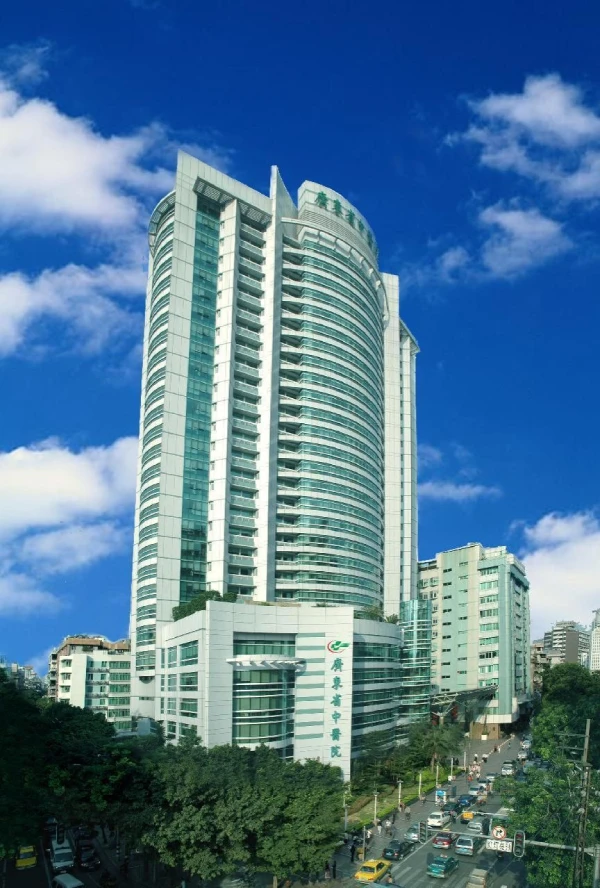
- Founded in 1933, it is one of the earliest TCM hospitals in modern China, known regionally as “the first TCM hospital of Lingnan.”
- It operates six campuses across Guangzhou, Zhuhai and Nansha, with the Dade Road headquarters and University Town campus hosting its international medical clinic areas.
- It has 3,219 open beds and more than 7,700 staff, including one academician, one national TCM Master and six “Qi-Huang” scholars.
- Its annual patient volume has ranked first among Chinese TCM hospitals for more than 20 consecutive years, per the hospital’s own figures.
- Its international medical facilities include a dedicated inpatient building of nearly 15,000 square meters with 92 private high-end beds, plus an outpatient zone combining multi-specialty consultation rooms, diagnostics, treatment and health observation.
- Specialty strengths listed by the hospital include preventive medicine (zhi wei bing, 治未病 — “treating before illness”), dermatology, respiratory and critical care medicine, breast disease, neurology, kidney disease and orthopedics, supported by more than 300 traditional TCM therapies and 336 in-house herbal preparations.
International patients now travel there from Vietnam, Indonesia, Malaysia, Pakistan, Ukraine, Italy and beyond.
Case Study: How One European Couple Structured Their TCM Assessment Request
(A real request handled by our concierge team; names and identifying details changed. Shared for illustration.)
“Martin” and “Lena” are a European couple living in China. When they began planning a comprehensive TCM assessment, they did something worth copying: each of them wrote down their priorities — specifically, separately, and in order.
Martin’s list:
- Internal and preventive TCM, including a general constitutional assessment
- Stress and emotional regulation
- Intermittent elevated blood pressure and cardiovascular health
- Previous knee surgery and occasional heel pain — noted as secondary
Lena’s list:
- Digestive and bowel function — TCM stomach and spleen regulation
- Preventive health and long-term vitality
- Very oily skin with recurrent skin eruptions on the chest, shoulders and back — for which she hoped to see a senior physician with dermatology expertise
And what they asked for, together:
A proper TCM assessment for each of them — medical history, pulse and tongue diagnosis, constitution and pattern assessment — followed by clear written conclusions and practical recommendations covering herbs, medication, diet and lifestyle where appropriate.
Notice how cleanly this request maps onto the structures described above. Martin’s profile points toward internal medicine and preventive assessment. Lena’s combines two tracks — digestive regulation and dermatology — which is precisely where multi-specialty arrangements add the most value: at this hospital, for example, the dermatology-led collaborative clinic launched in May 2026 already integrates skin, digestive (spleen-stomach), nutrition and psychological-sleep specialists into a single visit.
And by requesting written conclusions, the couple ensured the visit would produce documents they could take home, share with their own physicians, and act upon — rather than a conversation that fades.
(On expectations: an assessment produces individualized findings and recommendations. What those contain, and how any individual responds to them, varies from person to person — no specific outcome can be promised in advance.)
What a Complete TCM Assessment Involves
If you are considering a first TCM consultation, here is the standard framework:
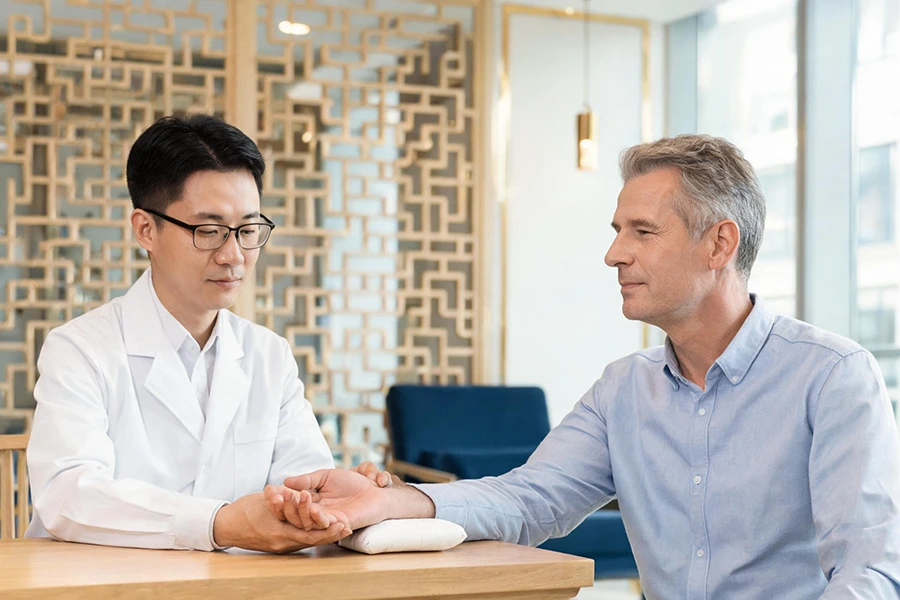
The four classical examinations (si zhen, 四诊). A TCM physician gathers information through observation (including tongue diagnosis), listening, inquiry and pulse diagnosis. Tongue and pulse findings are not stand-alone tests; they are read together with your full history.
Constitution and pattern assessment. The physician synthesizes all findings into a pattern identification (bian zheng, 辨证) — a description of how your body’s systems are currently functioning — often alongside a constitutional type (ti zhi, 体质). This is what makes recommendations personal rather than generic.
Written conclusions and practical recommendations. A well-documented visit ends with a written summary: findings, pattern interpretation and practical next steps, which may include herbal formulas, dietary guidance, lifestyle adjustments or referral for further evaluation. If you take any Western medication, bring a complete, current list — combining herbs with existing medication is a decision for your prescribing and treating physicians.
From our coordinators’ notebook — three things that consistently make TCM visits go better:
1. A priority list, written and translated before the visit. Physicians triage a structured request faster and more accurately than a verbal one.
2. A complete, current medication list. In our experience it is the single most commonly missing item at a first consultation — and the one whose absence slows everything down.
3. A half-day buffer for any multi-specialty visit. Coordinated consultations take longer than single appointments, and unhurried ones produce clearer decisions.
When Does MDT Make Sense — and When Is One Specialty Enough?
A single-specialty TCM visit is often the right start for a focused concern. Multi-specialty arrangements earn their value when:
- Several systems or specialties are involved at once — skin concerns alongside digestive issues, for instance
- Coordinating several separate opinions would otherwise mean multiple trips
- A case is complex, or has not responded to a single-track approach
One concrete example: in May 2026, the hospital launched a collaborative clinic for severe atopic dermatitis, led by Qi-Huang scholar Professor Chen Dacan. It integrates ten disciplines — dermatology, pediatrics, ENT, ophthalmology, psychological sleep medicine, respiratory medicine, spleen-stomach (digestive) medicine, nutrition, laboratory diagnostics and pharmacy — into one visit, as reported in the hospital’s official announcement. Clinics of this kind typically run on fixed weekly schedules, but timetables change, so confirm current arrangements through official channels before planning your trip.
How Orisene Supports the Journey
Orisene Health is a medical concierge and coordination service — not a hospital or clinic. We support international families and executives across our service cities — Guangzhou, Shenzhen and the Boao Lecheng International Medical Tourism Pilot Zone in Hainan — taking care of the parts that make cross-border healthcare smooth:
- Pre-visit preparation — organizing and translating medical histories and priority lists, so your physician starts with the full picture
- Scheduling and navigation — coordinating appointments, including multi-specialty arrangements, and guiding you through registration and hospital wayfinding
- In-clinic interpretation — bilingual coordinators who translate meaning, not just words
- Written documentation — structured English summaries of physician conclusions and recommendations, ready to share with physicians at home
- Confidentiality — your health information stays private. Always.
A note on Boao Lecheng: under its special-access policy, the pilot zone is currently the only area in China where designated medical institutions may use certain medicines and devices that are licensed abroad but not yet registered nationally, according to policy documents and peer-reviewed analyses. For patients weighing every available option, that makes it a meaningful addition to a care map built around Guangzhou and Shenzhen.
Frequently Asked Questions
Yes. International-friendly facilities are in place — the hospital’s international medical clinic areas operate at its Dade Road and University Town campuses — and bilingual coordination covers registration, consultation interpretation and written documentation.
A summary of your medical history, recent test results, a complete list of current medications, and a written list of your priorities — ideally in the style of the case study above.
That is a question for your treating physicians. Bring a full medication list to the consultation, keep your prescribing physician informed, and follow professional guidance on timing and dosage.
Typically one coordinated visit in which multiple specialists review your case together — history, findings and options discussed in one setting, and you leave with a consolidated plan rather than several separate opinions.
Yes. Our coordination covers our three service cities, and itineraries that pair a Guangzhou TCM or MDT visit with care in Boao Lecheng are a routine part of trip planning. Share your priorities and we will map the options.
Share your priorities and medical history with our concierge team. We prepare the translated documentation, coordinate scheduling, accompany you on the day, and deliver a written English summary afterward. Schedule a private consultation to begin.
Key Terms at a Glance
- Si zhen (四诊) — the four classical TCM examinations: observation, listening/smelling, inquiry and palpation (including pulse taking)
- Bian zheng (辨证) — pattern identification; the diagnostic synthesis that individualizes TCM recommendations
- Ti zhi (体质) — constitution; your body’s characteristic tendencies, assessed as part of a complete TCM evaluation
- Zhi wei bing (治未病) — “treating before illness”; TCM’s preventive-care tradition, now a hospital specialty in its own right
- MDT — multidisciplinary team; several specialists assessing one case together in a single coordinated visit
Sources and Update Note
This article draws on the following sources:
- Guangdong Provincial Hospital of Chinese Medicine — Hospital Introduction (official website: www.gdhtcm.com)
Disclaimer: This article is for general information only and does not constitute medical advice. Diagnosis and treatment decisions rest with licensed physicians. Individual experiences vary, and no outcome is guaranteed. Orisene Health is a concierge and coordination service, not a medical provider. Case details are anonymized and shared for illustration.