Le sunvozertinib est approuvé et utilisé en pratique clinique en Chine. La difficulté n’est pas de trouver le médicament, mais d’obtenir l’ordonnance, de trouver le canal d’approvisionnement et de réunir les documents nécessaires pour pouvoir le rapporter légalement chez soi.
Avant de poursuivre votre lecture
Ce guide explique comment accéder au traitement en Chine. Il ne constitue pas un avis médical et ne garantit pas qu’un patient en particulier se verra prescrire ce médicament. L’admissibilité dépend de votre profil mutationnel, de vos antécédents thérapeutiques et du jugement de l’oncologue qui vous prend en charge.
Tous les prix ci-dessous sont des instantanés datés et sont susceptibles d’évoluer. Nous ne communiquons pas de prix définitif tant qu’un hôpital ne l’a pas confirmé par écrit.
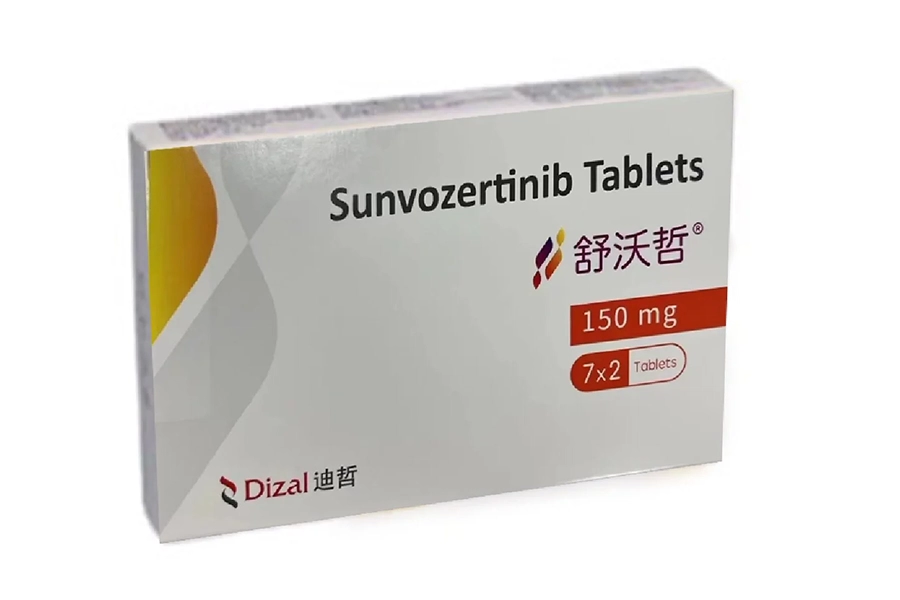
Table des matières
Le sunvozertinib est-il disponible en Chine ?
Oui. L’Administration nationale chinoise des produits médicaux (NMPA) a approuvé le sunvozertinib en août 2023 chez les adultes atteints d’un cancer du poumon non à petites cellules (CPNPC) localement avancé ou métastatique dont les tumeurs présentent une mutation d’insertion de l’exon 20 d’EGFR et dont la maladie a progressé après une chimiothérapie à base de platine. Le nom de marque chinois est 舒沃哲 (Shuwozhe); le nom de marque international est Zegfrovy. Le médicament a été développé par Dizal Pharmaceutical, à Shanghai.
En juillet 2025, la Food and Drug Administration (FDA) des États-Unis a accordé une autorisation accélérée pour la même indication après traitement à base de platine. Depuis, la distribution commerciale aux États-Unis est restée limitée, ce qui explique en partie pourquoi les patients porteurs de cette mutation se tournent vers la Chine.
Pourquoi des patients se déplacent pour obtenir ce médicament
Une enquête publiée en octobre 2026 par Le Washington Post en collaboration avec KFF Health News a documenté les déplacements de patients américains atteints d’un cancer en Chine pour obtenir des médicaments oncologiques de nouvelle génération, parce que ces médicaments ne sont pas encore approuvés dans leur pays, qu’ils sont approuvés mais pas encore disponibles en pharmacie, ou que leur prix est hors de portée. Pour une cible rare comme les insertions de l’exon 20 d’EGFR, l’écart entre l’approbation réglementaire et la disponibilité du médicament en pharmacie se mesure en mois, et un diagnostic n’attend pas.
Extrait de l’article : Les patients américains atteints d’un cancer ont besoin de médicaments qui leur sauveront la vie. Certains doivent aller les chercher en Chine.
Trois raisons pratiques reviennent régulièrement :
- Le médicament est déjà disponible. Le sunvozertinib est délivré dans les centres chinois de cancérologie depuis 2023 et figure sur la liste nationale de remboursement ; les circuits hospitaliers et pharmaceutiques sont donc établis et non expérimentaux.
- L’accès aux spécialistes est plus rapide. Si son dossier est prêt, un patient international peut généralement obtenir un rendez-vous dans un grand centre quelques jours après son arrivée, plutôt que d’attendre plusieurs semaines pour obtenir un rendez-vous dans son pays.
- Le prix affiché ne représente qu’une fraction des prix pratiqués en Occident lors du lancement. C’est une donnée utile pour établir un budget, pas un critère clinique : le prix ne justifie jamais de prendre un médicament qui ne convient pas à votre mutation.
Un médicament approuvé n’est pas nécessairement disponible en stock
Cette distinction est plus importante que toute autre sur cette page. Une autorisation nationale signifie que le médicament peut légalement être prescrit et vendu. Cela ne signifie pas que tous les hôpitaux en ont en stock, et encore moins qu’un visiteur peut entrer dans une pharmacie et l’acheter.
En Chine, le sunvozertinib parvient aux patients par deux circuits réglementés :
- Pharmacie hospitalière (院内药房). Les grands centres anticancéreux tertiaires en ont en stock pour leurs patients suivis en ambulatoire. La disponibilité varie selon l’hôpital et le mois, et le nombre de boîtes par ordonnance est souvent plafonné.
- Pharmacies DTP à double circuit (双通道 / DTP 特药药房). Les pharmacies de détail agréées sont autorisées à délivrer certains médicaments réservés à l’hôpital sur présentation d’une ordonnance hospitalière. C’est ainsi que de nombreux patients obtiennent le médicament lorsque l’hôpital lui-même ne l’a pas en stock — et cela nécessite généralement de vérifier les stocks à l’avance, souvent 24 à 72 heures avant la consultation.
Une pharmacie hospitalière ou une pharmacie DTP ne peut délivrer le médicament que sur ordonnance d’un médecin chinois agréé. Il n’existe aucune voie légale de vente au détail permettant de contourner cette exigence, et les médicaments anticancéreux sur ordonnance ne peuvent pas être achetés légalement en ligne en Chine.
À propos du programme pilote de Lecheng, à Hainan. Boao Lecheng permet l’utilisation de certains médicaments approuvés à l’étranger avant leur approbation nationale. Sunvozertinib étant déjà approuvé par la NMPA, il n’est pas nécessaire de passer par la voie de Lecheng — un point à connaître si l’on vous propose une “ version importée ” à un prix majoré.
À qui s’adresse le médicament — et à qui il ne s’adresse pas
Sunvozertinib est une thérapie ciblée. Ce n’est pas un médicament général contre le cancer du poumon, et il n’est pas interchangeable avec les inhibiteurs de l’EGFR dont la plupart des gens ont entendu parler.
Sur le plan pharmacologique, il s’agit d’un inhibiteur oral irréversible de la tyrosine kinase de l’EGFR, conçu pour être sélectif des variants avec insertion de l’exon 20. Ces insertions représentent environ 1–2% des CBNPC et modifient la forme de la poche de liaison du médicament, ce qui explique pourquoi les inhibiteurs de première et de troisième génération, tels que l’osimertinib, l’erlotinib et le géfitinib, sont peu efficaces contre elles. C’est cette lacune qui justifie l’existence d’un médicament spécifique — et pourquoi votre compte rendu de mutation doit préciser le variant, et pas seulement indiquer “ EGFR positif ”. Cette page explique les modalités d’accès ; déterminer si un agent ciblant l’exon 20 est préférable à un autre dans votre cas relève d’une question clinique, à laquelle on répond à partir de votre dossier complet, et non d’une page Web.
Il est indiqué pour les tumeurs présentant une insertion de l’exon 20 de l’EGFR, confirmée par un test moléculaire — généralement un séquençage de nouvelle génération sur tissu tumoral ou plasma. Si votre compte rendu indique “ délétion de l’exon 19 de l’EGFR ”, “ L858R ” ou “ amplification de l’EGFR ”, il s’agit d’une cible différente et d’une autre classe de médicaments.
Trois points pratiques sont souvent mal compris par les patients :
- Le test de mutation est le ticket d’entrée. Un compte rendu anatomopathologique indiquant seulement “ EGFR positif ” ne suffit pas. Vous avez besoin du variant précis, de la méthode de test, du laboratoire et de la date du prélèvement. Si le test a été effectué sur un échantillon de tissu datant de plus d’un an, l’oncologue peut demander une nouvelle analyse sur un échantillon actuel de tissu ou de sang.
- Les antécédents thérapeutiques comptent. L’indication approuvée concerne les patients après une chimiothérapie à base de platine. Si vous n’avez pas reçu de chimiothérapie à base de platine, ou si votre médecin estime que vous pourriez bénéficier d’un traitement de première ligne, il s’agit d’une discussion clinique. Une demande d’extension d’indication en première ligne a été déposée en Chine sur la base de l’étude mondiale de phase III WU-KONG28 et, en mai 2026, la NMPA lui a accordé un examen prioritaire — mais cet examen prioritaire est une décision de calendrier, et non une approbation ; l’utilisation en première ligne en dehors d’un essai ou d’une indication approuvée reste une décision qui relève de votre oncologue.
- L’enchaînement avec d’autres agents ciblant l’exon 20 est une question qui relève d’un spécialiste. Amivantamab and related agents act on the same mutation through different mechanisms. Do not switch or stack therapies on your own.
The practical consequence: no reputable provider should tell you that you are “eligible” before an oncologist has read your mutation report. If someone does, treat it as a sales signal rather than a medical opinion.
Le parcours légal pour les patients étrangers
Foreign patients are treated in China every day, and the pathway is ordinary — it is simply unfamiliar. Four rules define it.
1. You need to be seen in person
A prescription for this medicine cannot be issued from a medical-record review alone. There is no remote-prescribing workaround, and a video call with a Chinese doctor does not produce a dispensable prescription. Plan for at least one in-person visit.
2. A foreign prescription cannot be filled
Your home-country prescription has no legal standing in a Chinese pharmacy. The Chinese prescription must come from a licensed physician at a Chinese medical institution, and it is issued in the hospital’s own system. Bring your overseas prescription and oncologist’s summary anyway — they are clinical background for the Chinese doctor and supporting paperwork on the way home.
3. Entry status must be sorted out first
China’s 240-hour visa-free transit applies to travellers from a specified list of countries who are passing through to a third destination. It is a transit facility, not a medical-stay visa, and it expires. If your consultation, testing and dispensing will span more than a few days — which is common — apply for the appropriate visa before you book anything. Confirm your own case with the nearest Chinese embassy or visa centre rather than relying on a general list.
4. The hospital, not an agent, controls the prescription
No concierge can guarantee that a prescription will be written. What a good one can do is make sure the oncologist has everything needed to make a decision on the day, and that nothing is lost between departments.
What to bring
Complete records change the outcome of a first visit more than anything else. Bring, at minimum:
- Passport and entry documents, plus a copy of your visa or entry stamp.
- Pathology report with the histological diagnosis and the date of biopsy.
- Molecular testing report: the panel used, the exon 20 insertion variant, variant allele frequency, the laboratory, and the sample date.
- All imaging from diagnosis onward — CT, MRI, PET-CT — as DICOM files on a USB drive or disc, not only printed films or phone photos, with the radiology reports. If a new baseline may be needed, a scan from the last four to six weeks is what the oncologist will ask for; older scans still show the trend, so bring both.
- Treatment history: drugs, cycles, dates, best response, reason for stopping, and any toxicity.
- Current medication list, allergies, and recent blood counts, liver and kidney function, and an ECG.
- A one-page summary in English signed by your treating physician, if you can obtain one.
English is generally workable at international departments, but pathology and molecular reports are the documents most often mangled by informal translation apps. Have the mutation details checked by a professional, and keep the original laboratory PDFs. For the full pre-travel list — payment, connectivity, and arrival logistics — see our China medical travel checklist.
Organiser une consultation, étape par étape
A realistic sequence for a patient coming from abroad. The whole path usually takes one to two weeks from first contact, assuming records are complete and the specialist has an opening. Nobody can honestly promise a specific date in advance.
- Pre-visit record review
Your records are organised into a single clinical summary and checked for the three things a thoracic oncologist will look for first: confirmed exon 20 insertion, prior platinum exposure, and current organ function. Missing items are flagged before you travel, not after you arrive. - Hospital and specialist matching
Hospitals differ in whether they hold the drug, how their international department runs, and which subspecialist is available. The shortlist below is a starting point, not a ranking — the right choice depends on your case and on current availability. - Appointment confirmation and written fee schedule
Registration is made through the hospital’s official channel. Ask for the consultation fee, expected tests and the dispensing route in writing before you commit to travel dates. - In-person assessment
The oncologist reviews your history, may order imaging or bloodwork, and decides whether sunvozertinib is appropriate. This is the step that produces — or does not produce — a prescription. Bring your original materials. - Dispensing and the paperwork file
The prescription is filled at the hospital pharmacy or a designated DTP pharmacy. Before you leave the counter, assemble the documents listed in section 06; replacing them later from another country is slow and sometimes impossible.
Hospitals international patients ask about
These are institutions international patients commonly ask about for thoracic oncology in the Greater Bay Area. They are examples to investigate, not a recommendation, and none of them has reviewed or endorsed this page. Availability of any specific drug must be confirmed with the hospital at the time of booking.
| Hospital | Ville | What patients usually go there for |
|---|---|---|
| Centre de cancérologie de l’Université Sun Yat-sen | Canton | National-level cancer centre with a large thoracic oncology practice and an international clinic accustomed to overseas records. |
| Hôpital Fosun Chancheng de Foshan | Foshan | JCI-accredited hospital with an international medical centre; convenient for follow-up visits near Guangzhou. |
| Hôpital populaire de la province du Guangdong | Canton | Home to the Guangdong Lung Cancer Institute; strong record in EGFR-mutated NSCLC and rare EGFR variants. |
| Le Premier Hôpital affilié de l’Université Sun Yat-sen | Canton | Broad multidisciplinary support; often used when a patient has significant comorbidity or brain metastases. |
| Premier hôpital affilié à l’Université de médecine de Guangzhou | Canton | National Centre for Respiratory Medicine; a natural fit for lung cancer and thoracic disease. |
| Hôpital Nanfang, Université de médecine du Sud | Canton | Large tertiary teaching hospital with a dedicated international medical centre. |
Hospital names are given in English and Chinese for booking purposes. Verify the department, the specialist and drug availability directly with each institution; details change.
Combien ça coûte
Cost questions deserve arithmetic rather than adjectives. Below is the medicine calculation, then the other lines that patients forget to budget for.
The medicine
Sunvozertinib is supplied as 150 mg tablets, 14 to a box. At the standard dose of 300 mg once daily — two tablets — one box covers seven days, and a 28-day cycle takes four boxes.
When it launched, the public list price was around RMB 9,040 per box. After inclusion in China’s National Reimbursement Drug List in early 2025, the listed price fell by more than half. A public price list at a Shenzhen hospital in September 2026 showed RMB 4,160.24 per box; other institutions list somewhat higher, in the region of RMB 4,320 to 4,960 per box.
| One box · 14 tablets · 7 days | RMB 4,160 – 4,960 |
| 28-day cycle · 4 boxes at 300 mg daily | RMB 16,640 – 19,840 |
| 28-day cycle · 2 boxes at a reduced 150 mg daily | RMB 8,320 – 9,920 |
| Approximate in US dollars (standard / reduced) | ≈ US$2,300 – 2,750 / 1,160 – 1,380 |
| Per month of treatment, medicine only | ≈ RMB 17,000 – 20,000 |
Converted at roughly RMB 7.2 to the US dollar. These are snapshots of listed self-pay prices at named institutions in September 2026. They are not national prices, not quotations, and not forecasts. Provincial tendering, hospital level and pack configuration all move the number, and a written hospital quote is the only figure worth planning around. At 150 mg daily a box covers 14 days rather than seven, so the monthly box count halves — which is exactly why a per-box price alone hides the real cost.
Reimbursement does not usually apply to you. The National Reimbursement Drug List lowers the price for eligible Chinese residents covered by social insurance. International self-pay patients generally pay the listed price. If you hold private international insurance, check whether it reimburses overseas pharmacy purchases — most policies require pre-authorisation, and direct billing at a Chinese hospital pharmacy is rare.
The rest of the bill
| Line item | What drives it | Indicative range (verify) | How to handle it |
|---|---|---|---|
| Specialist consultation | Hospital tier, and whether you are seen in an international department or a standard clinic. | International / VIP clinic RMB 500 – 1,500 per visit; standard expert clinic RMB 50 – 300. | Request the fee schedule in writing; international department fees are higher and are not negotiable. |
| Imaging and laboratory work | Whether existing scans are accepted, and whether a repeat molecular panel is required. | Roughly RMB 800 – 4,500. | Bring DICOM files; a repeat NGS panel is often the largest single test line. |
| Accommodation and transport | Length of stay, city, and airport transfers. | Varies by origin and itinerary. | Budget for at least one extra week in case tests or dispensing slip. |
| Interpretation and coordination | Number of appointments, complexity of the case, whether written translation is needed. | Quoted by scope. | Confirm what is included rather than assuming a per-day rate covers reports. |
Indicative ranges only, compiled from publicly available sources and subject to verification. Hospital charges are paid directly to the hospital or pharmacy; concierge fees are separate and quoted in writing.
Verify before you pay
- Ask for the price per box et the number of boxes needed for 28 days — a per-box price alone hides the real monthly cost.
- Confirm whether the quote is the list price or includes any hospital service fee.
- Ask for the batch number and expiry date of the stock that will actually be dispensed.
- Get the dispensing location in writing: hospital pharmacy or named DTP pharmacy.
- Confirm the maximum number of boxes a single prescription can cover — it is often capped, and it determines how much you can legally carry home.
- Never pay a deposit to an individual. Payment should go to the hospital or pharmacy, or to a company you can verify.
Pouvez-vous l’emporter chez vous ?
This is the question patients ask last and should ask first. “Can I take it home” is really two separate legal questions — leaving China, and entering your own country — and both have to be answered yes.
Leaving China
Chinese customs rules permit travellers to carry a reasonable quantity for personal use, supported by a prescription and proof of medical need. “Reasonable” is assessed case by case; a quantity that looks like resale stock will not be treated as personal use. Keep the medicine in its original packaging, carry it in hand luggage rather than checked baggage, and keep the paperwork with it rather than in a suitcase.
Mailing or couriering prescription medicines out of China is a different activity with different rules, and it is not a route we use or recommend.
Entering your country
Your destination’s rules decide the answer, and they are not harmonised. The table below describes the general position in each jurisdiction; the linked regulator is the authority, not this page.
| Jurisdiction | Typical personal-import position | Key condition |
|---|---|---|
| United States | FDA may exercise enforcement discretion for up to a 90-day supply. | Discretionary, not an entitlement. Generally requires a serious condition, no adequate domestic alternative, no commercial distribution, and a prescription; not for resale. |
| European Union | Set by member state, commonly around a 30-day personal supply. | Prescription and proof of personal use; some states require prior authorisation. Germany, France and the Netherlands differ. |
| United Kingdom | Generally up to a three-month personal supply. | Must be prescribed for you and carried for your own use; licensed-medicine rules still apply on entry. |
| Canada | Generally up to a 90-day personal supply. | Prescription or equivalent documentation; Health Canada retains discretion. |
| Australia | Personal importation scheme, generally up to three months. | TGA conditions apply, including that the medicine is for your own treatment. |
General positions as commonly applied. Individual cases can be refused; confirm with the regulator or a customs broker before purchase.
The document file that decides it
Assemble this before you leave the hospital, not at the airport:
- Original prescription, with the hospital’s official seal.
- Hospital invoice or official receipt showing the medicine, quantity and price.
- A medical record or discharge summary stating the diagnosis, the mutation, and that the medicine is for your personal treatment.
- Original outer carton with the batch number and expiry date legible.
- Your own prescription from home, if you have one, and a physician’s letter in English explaining the treatment plan.
- A copy of everything, kept separately from the originals.
Get the answer in writing before you pay. If your country’s regulator, your insurer, or a customs broker tells you the quantity is acceptable, keep that correspondence. If nobody will confirm it, buy only what you can legally carry and plan a follow-up visit or a domestic alternative.
If the drug is approved at home
Since the U.S. accelerated approval in 2025, and with further launches expected, local sourcing may become simpler than importing. Availability and reimbursement in your own country usually beat a carry-home plan on continuity of supply — worth checking before committing to a China trip for the medicine alone.
Ce qu’un concierge médical peut et ne peut pas faire
Patients arrive with wildly different expectations of what “concierge” means. Here is our own boundary, stated plainly.
What we do
- Organise records into a clinical summary a Chinese oncologist can read quickly, and flag what is missing.
- Match the case to hospitals and specialists, and book through official channels.
- Provide a medical interpreter at appointments, including consent discussions and pharmacy instructions.
- Accompany you through registration, testing, dispensing and follow-up scheduling.
- Verify hospital and DTP pharmacy stock and prescription policy before you travel.
- Translate reports afterwards and coordinate remote follow-up with the treating team.
What we do not do
- We do not diagnose, prescribe, or advise for or against a specific drug. That is the oncologist’s role.
- We do not guarantee a prescription, a hospital bed, a visa, a customs outcome, or a fixed appointment date.
- We do not buy queue positions, use scalpers, or make any payment to a clinician or hospital employee. All bookings go through official channels.
- We do not carry or ship medicine on your behalf, and we do not hold stock.
- We do not share your records with any third party without your written consent.
Orisene Health is a navigation and coordination service — a service partner, not a clinic. We are independent of hospitals and pharmaceutical companies, and we take no referral fee from either. Medication and hospital charges are settled directly with the hospital or pharmacy. If a recommendation cannot be explained in terms of your case, it should not be trusted — ours included.
Questions fréquentes des patients
Le sunvozertinib est-il approuvé en Chine ?
Oui. La NMPA l’a approuvé en août 2023 pour les adultes atteints d’un CBNPC localement avancé ou métastatique présentant une insertion de l’exon 20 d’EGFR, après progression de la maladie sous chimiothérapie à base de platine. Il est commercialisé en Chine sous le nom de 舒沃哲 (Shuwozhe). L’admissibilité de chaque patient reste déterminée par le jugement clinique.
Puis-je l’acheter sans consulter un médecin ?
Non. Ce médicament est délivré uniquement sur ordonnance, laquelle doit être établie par un médecin agréé en Chine après une évaluation en personne. Les ordonnances étrangères ne peuvent pas être exécutées en Chine, et les médicaments oncologiques soumis à prescription ne peuvent pas être achetés légalement en ligne en Chine.
Combien cela coûte-t-il par mois ?
Aux prix en paiement direct de septembre 2026, soit environ 4 160 à 4 960 RMB par boîte de 14 comprimés, un cycle de 28 jours comprenant quatre boîtes revient à environ 16 640 à 19 840 RMB — soit environ US$2,300 à 2,750. Il s’agit d’une référence datée, et non d’un devis.
L’assurance le prend-elle en charge ?
China’s national reimbursement applies to eligible residents with social insurance; international self-pay patients generally pay list price. Private international insurance sometimes reimburses overseas pharmacy purchases, but usually requires pre-authorisation, and direct billing at a Chinese hospital pharmacy is uncommon.
Puis-je l’emporter chez moi ?
Parfois. Les douanes chinoises autorisent une quantité raisonnable pour usage personnel sur présentation d’une ordonnance et d’un justificatif de nécessité médicale. Votre pays de destination fixe ses propres limites — la politique des États-Unis est laissée à l’appréciation des autorités et la quantité est généralement limitée à 90 jours de traitement, tandis que les règles varient dans l’UE, au Royaume-Uni, au Canada et en Australie. Vérifiez les règles des deux côtés avant d’acheter.
Pouvez-vous expédier les médicaments dans mon pays ?
Non. L’envoi transfrontalier de médicaments sur ordonnance par la poste ou par coursier n’est pas un moyen légal d’importation à titre personnel dans la plupart des juridictions, et nous ne proposons pas ce service. Le médicament doit voyager avec vous, dans son emballage d’origine et accompagné des documents nécessaires.
Combien de temps faut-il pour organiser un rendez-vous ?
Comptez plusieurs jours ouvrés à environ deux semaines pour obtenir un rendez-vous auprès d’un service international à Guangzhou ou Shenzhen, selon le spécialiste et le degré de complétude de votre dossier médical. Nous réservons par les canaux officiels et ne pouvons donc pas garantir une date précise.
Dois-je parler chinois ?
Pas pour l’inscription, mais vous aurez besoin d’un interprète pour la consultation en oncologie, les formulaires de consentement et les conseils pharmaceutiques. L’interprétation médicale n’est pas la même chose qu’une traduction conversationnelle, en particulier lorsqu’il est question d’effets secondaires et de modifications de posologie.
Que faire si ma tumeur ne présente pas d’insertion de l’exon 20 ?
Ce médicament n’est donc pas indiqué pour vous. Il cible spécifiquement les mutations par insertion de l’exon 20 et ne remplace pas l’osimertinib ni les autres inhibiteurs utilisés pour les délétions de l’exon 19 et la mutation L858R. Demandez à votre oncologue quelle option convient à votre variant.
Est-il plus efficace que l’amivantamab ?
Cette page ne peut pas répondre à cette question, et toute personne qui y répond sans disposer de votre dossier médical complet ne fait que deviner. Les deux agissent sur le CBNPC avec insertion de l’exon 20 selon des mécanismes différents, avec des niveaux de preuve et des profils de tolérance distincts. Cette comparaison relève de votre oncologue traitant.
Sources et vérification
This guide was written from primary regulatory documents, published price disclosures and reporting, and reviewed on 26 October 2026. We do not use patient testimonials, and we do not present estimates as quotations. Where a figure comes from a single institution, we say so, and hospital price lists are cited with the date they were accessed. Regulatory and customs statements are cited to the issuing authority, which remains the authority — not this page.
- China National Medical Products Administration (NMPA), approval announcement for sunvozertinib tablets, August 2023. english.nmpa.gov.cn
- U.S. Food and Drug Administration, “FDA grants accelerated approval to sunvozertinib for metastatic NSCLC with EGFR exon 20 insertion mutations”, July 2025. fda.gov
- AstraZeneca, press release on the global licence agreement for ZEGFROVY (sunvozertinib), September 2026. astrazeneca-us.com
- Dizal Pharmaceutical, product and pipeline disclosures, including the first-line supplemental application and the WU-KONG28 phase III programme. dizalpharma.com
- China National Health Commission, Measures for the Supervision and Administration of Prescriptions — dispensing of prescription medicines by medical institutions. nhc.gov.cn
- Drug Administration Law of the People’s Republic of China (2019 revision). english.nmpa.gov.cn
- China General Administration of Customs, passenger clearance guidance — personal-use quantity assessment for medicines carried across the border. english.customs.gov.cn
- Shanghai Municipal Government, guidance on carrying personal medicines into or out of China. english.shanghai.gov.cn
- U.S. FDA, “Personal Importation”, Import Basics. fda.gov
- U.S. Customs and Border Protection, guidance on bringing medications into the United States. help.cbp.gov
- Shenzhen New Frontier United Family Hospital, public drug price list, accessed 22 September 2026 (sunvozertinib 150 mg, 14 tablets per box, RMB 4,160.24). szufh.hk
- PharmCube, reporting on the post-reimbursement price adjustment for sunvozertinib. pharmcube.com
- The Washington Post / KFF Health News, reporting on international patients travelling to China for oncology medicines, 20 October 2026. washingtonpost.com
- Orisene Health, China medical travel checklist — the intake document we use to prepare a first consultation.